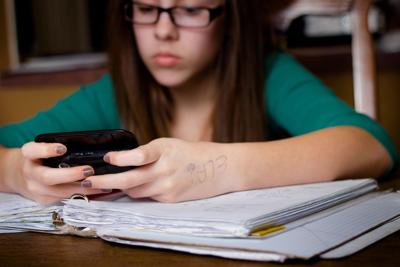


Photo provided by DepositPhotos
The 2024 Nation's Report Card delivered some of the worst results in the assessment's history. Forty-five percent of high school seniors scored below NAEP Basic in math, the highest share ever recorded. Reading scores for 4th and 8th graders dropped five points from 2019. Educators are still working through what the numbers mean, but a growing body of research keeps pointing at the same factor: phones.
72% of Teachers Call Phones a Major Classroom Problem
Almost three quarters of high school teachers now say cellphone distraction is a major problem in their classrooms, according to Pew Research data cited in Education Next.
People are also reading…
Research from Dr. Gloria Mark at UC Irvine adds another layer. Focused attention on a screen has dropped from about 2.5 minutes in 2004 to roughly 47 seconds today. Stress markers and heart rate climb alongside the switching.
More Than Half of US States Have Passed School Phone Laws
More than half of US states passed laws regulating phones in schools heading into the 2025 to 2026 academic year, according to the Education Next research. Some require lockable pouches. Others mandate bell-to-bell phone-free policies. Early reporting from schools that have already gone phone-free points to changes in class participation and student interaction, though long-term data is still coming in.
Students Turn to Focus Apps, Timers, and Phone-Free Study Sessions
Students aren't waiting for the policy debate to settle. Search interest in focus techniques and study tools has climbed, and a few approaches keep surfacing as the ones that work.
Phone-free environments. Research from UT Austin found that simply having a phone in another room, not face-down on the desk, improves working memory performance. Out of sight beats out of hand.
The Pomodoro Technique. Short, bounded work intervals followed by short breaks. Cognitive scientists like the structure because it works against the checking reflex that smartphones encourage. Free Pomodoro timers pair the timer with study material so attention doesn't drift back to the phone between intervals.
Site and app blockers. The free version already sits on every student's phone: iOS Screen Time and Android Digital Wellbeing both allow scheduled blocks and app limits.
Active recall and spaced repetition. The most evidence-backed study method in cognitive psychology, thanks to decades of work from researchers like Roediger and Karpicke. Flashcard tools and spaced repetition apps put the technique into practice without requiring a curriculum overhaul.
Why the Phone Fight Doesn't End at Dismissal
A timer doesn't replace a teacher, and a pouch doesn't replace a parent. But the focus problem is now measurable, and it's showing up across test scores, teacher surveys, attention research, and statehouse votes.
The next question is whether the classroom reset translates to a habit reset. Schools can take the phones away for seven hours a day. Whether students hold onto any of that focus once they walk out the door is up to them, and the tools they choose to use.